

Sea Moss, Smoothies, and Erewhon
A look at the trendy algae quietly taking over wellness culture.


For those of us in academia, graduation season is equal parts celebration and survival. I spent this past weekend in Los Angeles for my niece’s college graduation. A very quick, very packed, two-day trip filled with family dinners, inspirational speeches, and just under three free hours before my flight home. Naturally, I did what any nutrition professional with mild occupational curiosity would do: I went to Erewhon.
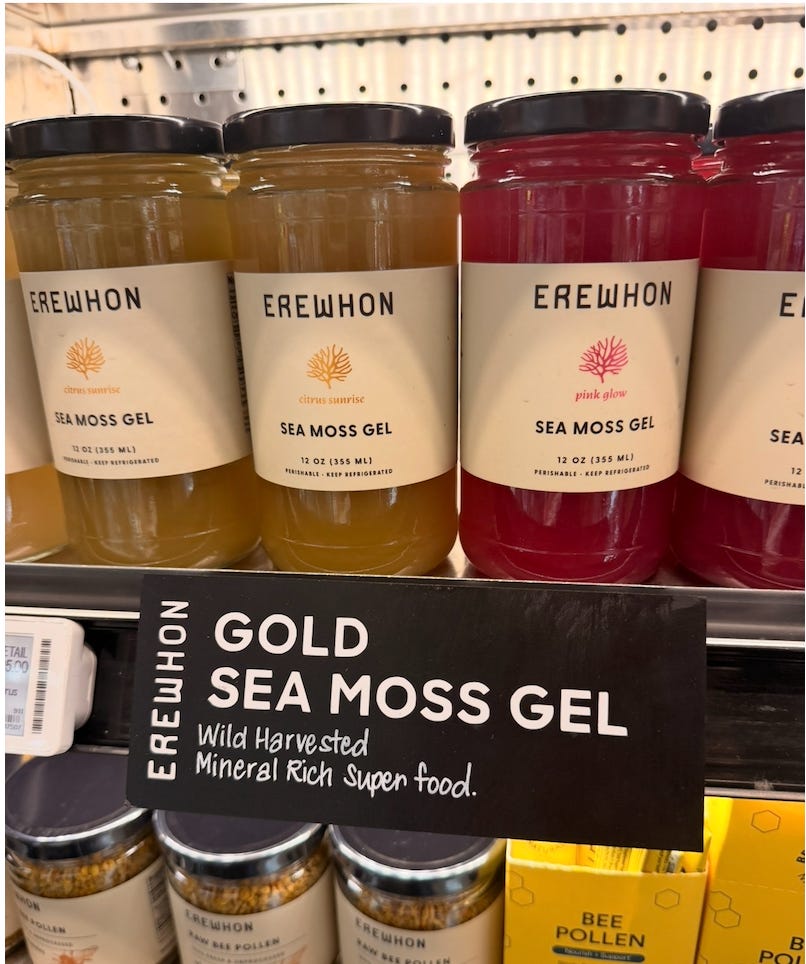
Erewhon is the upscale wellness market that somehow manages to make groceries feel both therapeutic and aspirational. Part of the fun of places like this is anthropological. I wanted to see what the current wellness obsession looked like in the wild. What’s replacing coconut oil and celery juice? What ingredient has quietly worked its way into smoothies, gummies, powders, and supplements?
The answer was sea moss. It was everywhere. And yes, in a moment of complete predictability, I ordered the Strawberry Glaze Skin smoothie (aka Hailey Bieber smoothie) because if I’m going to investigate wellness culture, I may as well fully commit.

It was delicious, but my skin did not leave with a new sense of purpose. What did catch my attention, though, was the ingredient list. There it was: sea moss. Of course it was.
So naturally, I had questions. What exactly is sea moss? And more importantly, what is this supplement actually selling us?

What is sea moss, and what exactly is the supplement selling me?
Sea moss, most commonly referring to Chondrus crispus or Irish moss, is a species of red algae that has been consumed for centuries in Ireland, the Caribbean, and parts of Asia.
However, recently, it has undergone a full wellness rebrand, showing up in gels, powders, capsules, gummies, and smoothies. And depending on who’s talking, it can apparently improve gut health, immunity, inflammation, skin, energy, metabolism, and thyroid function. That’s a fairly ambitious résumé for algae.
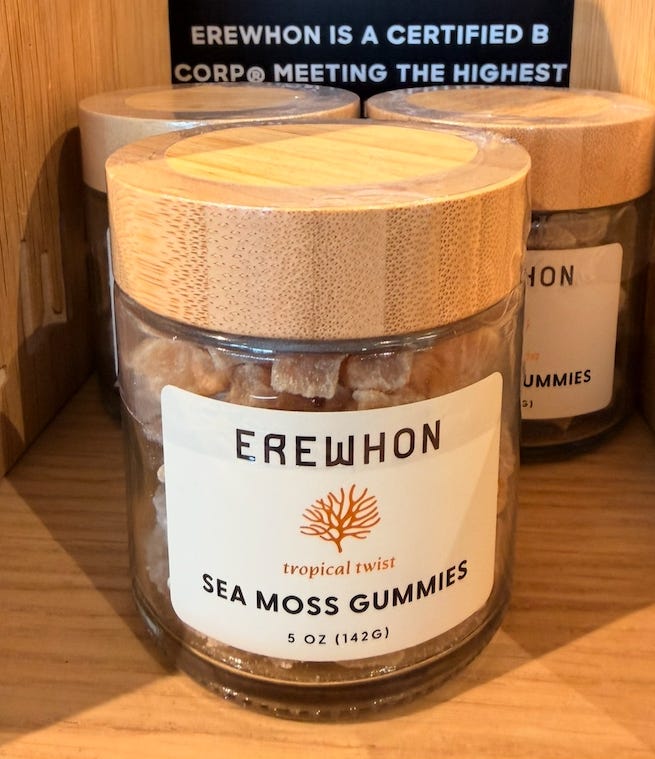
To be fair, sea moss is nutritionally interesting. Analytical studies on Chondrus crispus show that it contains minerals like calcium, iron, and zinc, along with amino acids, fatty acids, carotenoids, polyphenols, and polysaccharides such as carrageenan.
So unlike many wellness products built almost entirely on marketing language, sea moss does contain biologically active compounds. The problem is that finding a nutrient in a test tube is not the same thing as proving a health benefit in humans.
It’s the nutritional equivalent of seeing an outfit look incredible on Gisele Bündchen and assuming it’ll fit, flatter, and drape the same way on you.

Is there real science here?
Some, yes. But most of it is still early-stage.
For example, in vitro fermentation studies suggest compounds in Chondrus crispus may promote the growth of beneficial bacteria such as Akkermansia muciniphila, Bifidobacterium, and Lactobacillus. The key phrase there is in vitro.
These effects were observed in controlled laboratory models, not in humans routinely consuming sea moss supplements in real-world settings. Human evidence remains limited.
That distinction matters because many compounds that look promising in isolated laboratory environments fail to produce meaningful effects once they encounter the far messier reality of the human body.

OK, but what is sea moss actually supposed to help with?
One of the more physiologically relevant aspects of sea moss is its iodine content, which makes sense since seaweed is naturally one of the richest dietary sources of iodine. Iodine is essential for thyroid hormone production.
But iodine is one of those nutrients where both too little and too much can create problems.
Excessive intake may contribute to thyroid dysfunction, including hyperthyroidism or hypothyroidism. And iodine concentrations in seaweed products can vary substantially depending on species, harvesting conditions, and processing.
So while sea moss is often marketed as “thyroid supportive,” that framing can become misleading quickly, particularly for individuals with pre-existing thyroid conditions or those already taking iodine-containing supplements.
Then there’s gut health.
Sea moss is a major natural source of carrageenan, the polysaccharide responsible for its gel-like texture. And carrageenan is where the conversation becomes more complicated.
However, researchers also note that food-grade carrageenan consumed within whole food matrices behaves differently from isolated carrageenan used experimentally, and many animal studies use doses far beyond typical human intake.
In other words, the current evidence does not support panic. But it also doesn’t support the sweeping claim that sea moss universally heals the gut. At the moment, the science is somewhere between promising and please calm down.

Is sea moss harmless, or are there actual concerns?
Potentially, there can be concerns.
Seaweeds naturally bioaccumulate minerals from their environment, including trace metals. Studies have detected mercury and lead in some seaweed products, although typical intake levels do not appear to pose major health risks for the general population.
Still, sourcing and quality control matter, particularly in the supplement space, where contamination and standardization can vary considerably.
It’s also worth remembering that dietary supplements operate under a very different regulatory framework than medications.
Under the 1994 Dietary Supplement Health and Education Act (DSHEA), supplement manufacturers do not need to prove that a product works before bringing it to market. Nor do they need to demonstrate that it delivers the health outcomes implied in marketing claims.
In other words, efficacy is not a prerequisite for being sold.
Their primary legal responsibility is that the product contains the ingredients listed on the label and is not overtly unsafe when used as directed.
That doesn’t mean all supplements are ineffective. But it does mean consumers often assume a level of scientific validation that may not actually exist, particularly in wellness categories where enthusiasm tends to move much faster than human clinical evidence.

Sea moss is a nutrient-dense marine food with an interesting mineral profile and biologically active compounds that show promise in preclinical research.
But the current health claims surrounding sea moss substantially outpace the available human evidence. At present, there are no large, well-designed human clinical trials specifically evaluating sea moss/Chondrus crispus supplementation for meaningful health outcomes.
Which doesn’t mean sea moss is useless. It simply means the science currently supports “it’s interesting and worth studying further”.