


I feel like my algorithm is messing with me.
For reasons unclear, ghee keeps showing up in my feeds. In recipes. In wellness posts. In videos from people I follow and some from those I don’t. If I believe what I see online, there are a growing number of people spooning clarified butter into sauté pans, drizzling it over vegetables, and talking about it like it’s liquid gold.
The irony is that I don’t even use ghee. I’ve never paid much attention to it, mostly because I tend to be mindful of concentrated sources of saturated fat.
But maybe the algorithm sensed weakness. Or maybe, after spending weeks organizing a medical conference focused on cardiovascular disease prevention and management through nutrition, my phone has decided I now need a distraction.
Because here’s the thing: much of the messaging online around ghee seems to drift far from what we know about dietary fats and cardiovascular health.
So today, I want to take a closer look at ghee and figure out whether the algorithm is trying to teach me something or simply sabotage me.

So, what exactly is ghee?
To understand ghee, you first have to understand butter.
Butter is essentially concentrated milk fat (aka cream). It’s made by churning cream until the fat separates from the liquid (which is buttermilk).
In fact, you can make butter yourself at home. Pour heavy cream into a stand mixer and keep beating it long enough, and eventually something slightly magical happens: the whipped cream “breaks,” the fat clumps together, and butter is born.
Butter Basics
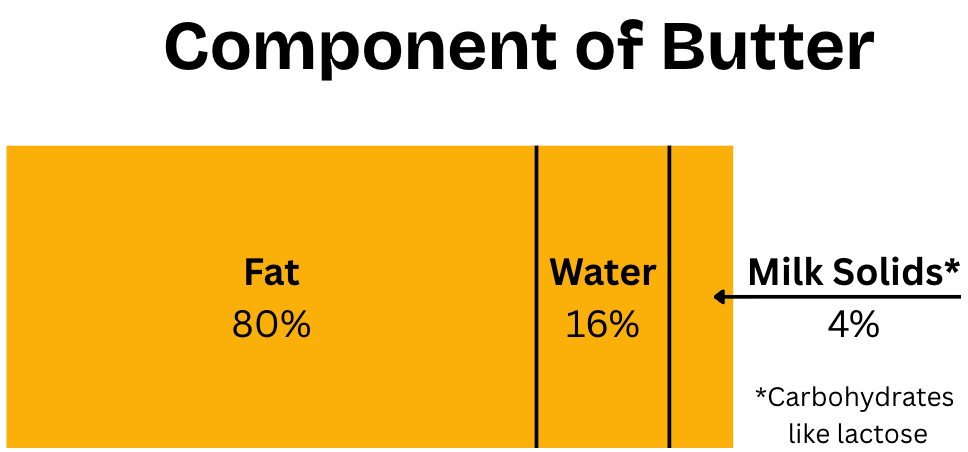
*Milk solids include small amounts of proteins, lactose (milk sugar), and other carbohydrates and compounds that contribute flavor and browning.
Ghee starts as butter and then moves on to become clarified butter. To prepare it, butter is gently simmered until its water evaporates and the milk solids separate and lightly brown. The remaining golden fat is then strained, and once the water and milk solids are removed, what remains is the fat.
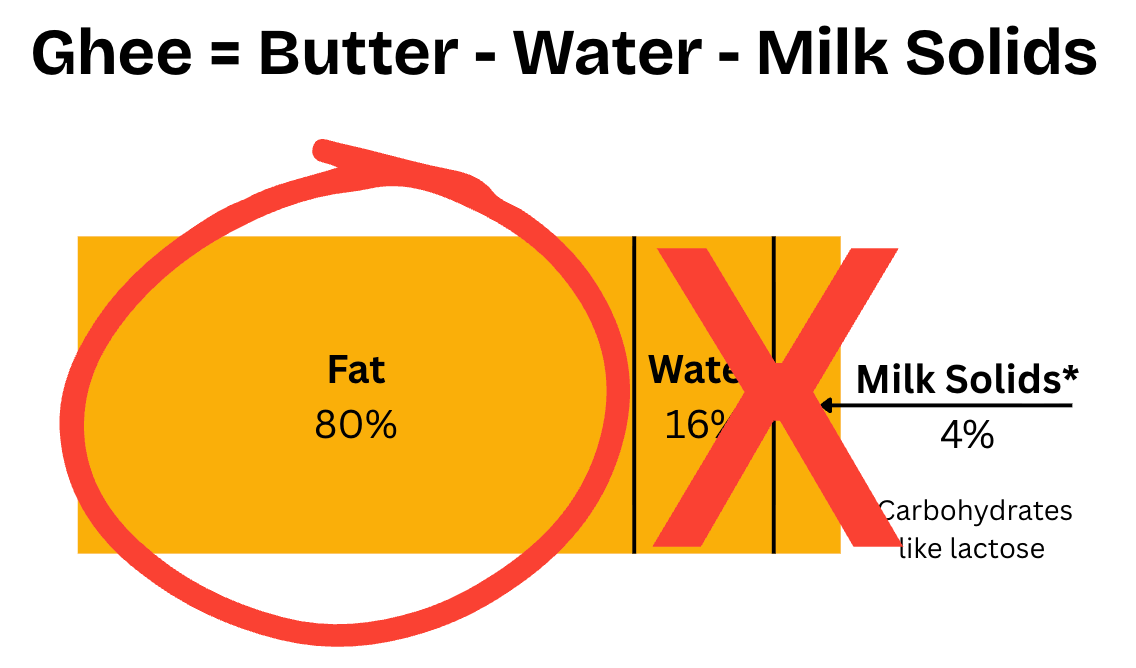
Nutritionally, ghee is entirely fat, and a large percentage of that fat is saturated fat. On average, roughly 60–73% of the fatty acids in ghee are saturated.
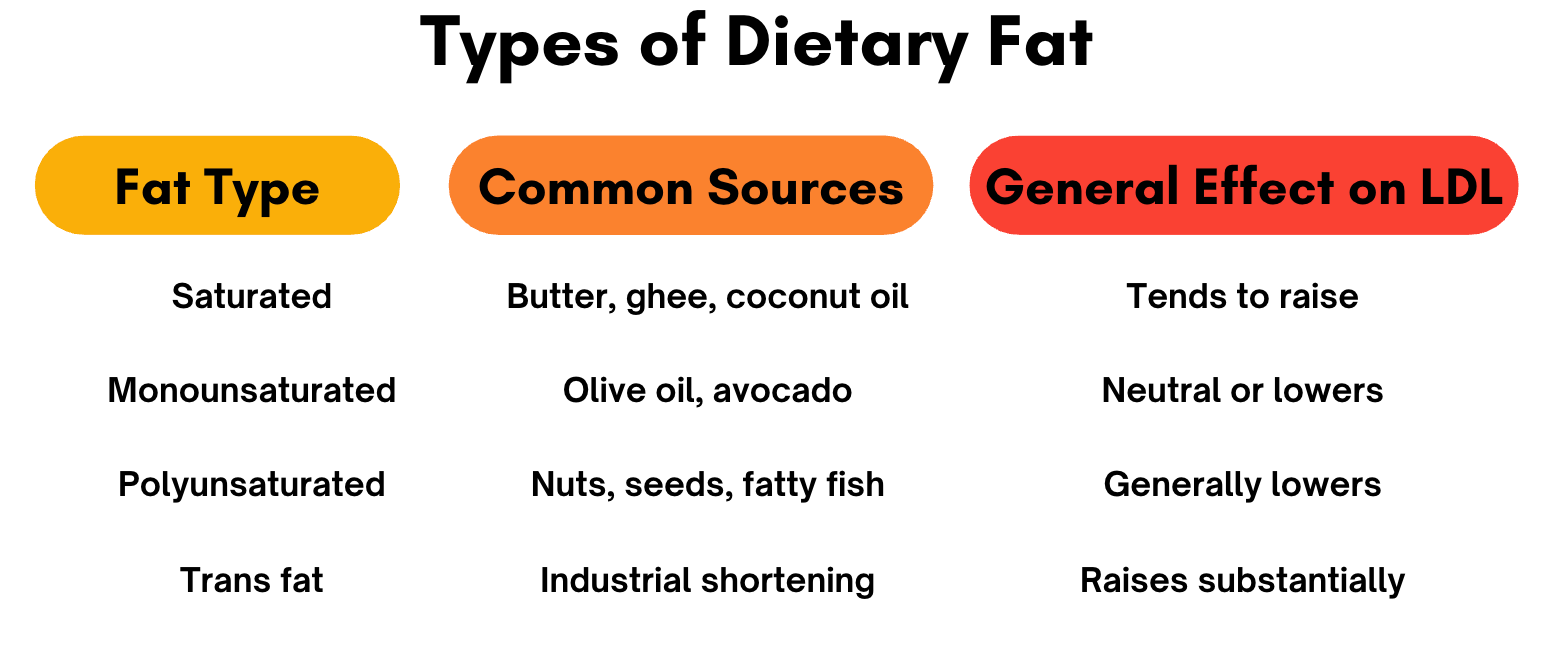
Which means ghee is not some unique category of food; it is fundamentally a saturated fat. Saturated fats tend to raise LDL cholesterol and apoB-containing lipoproteins in many individuals, which matters because these particles play a central role in the development of cardiovascular disease.
That does not automatically make it harmful. But it does mean it should not be evaluated outside the same nutritional frameworks we apply to other dietary fats.

Then why does Ayurveda think ghee is so special?
In Ayurvedic medicine, ghee occupies a very important role.
It has traditionally been viewed as a healing fat, believed to support digestion, nourish tissues, enhance cognition, promote longevity, support immunity, and serve as a carrier for medicinal herbs and botanical compounds.
That last claim actually has a degree of scientific plausibility: ghee may help deliver certain medicinal compounds. Modern studies have shown that certain herbal compounds achieve better absorption when delivered in a lipid-based medium rather than in water alone.
But here’s the important nuance: this is not unique to ghee.
Any dietary fat, whether olive oil, avocado, yogurt, peanut butter, or butter itself, can help improve the absorption of certain fat-soluble compounds and vitamins. That is simply part of how human digestion works.
So while Ayurveda may have correctly identified that fats can act as delivery systems, that does not automatically validate the broader claims that ghee itself is a cardiovascular superfood or detoxifier.
Those claims remain largely unproven in rigorous human studies.

OK, but there must be evidence of other health benefits?
Yes, but most of the exciting findings come from animal studies, not humans.
One area that gets attention is ghee’s content of conjugated linoleic acid (CLA), a naturally occurring fatty acid found in dairy fat. In rodent studies, CLA-enriched ghee has shown antioxidant effects and improvements in cholesterol markers.
And while ghee from grass-fed butter may contain slightly higher amounts of compounds like CLA and fat-soluble vitamins, the quantities are relatively small compared to the overall saturated fat load and do not currently outweigh the broader evidence of cardiovascular risk.
Other animal studies found something surprising: rats fed ghee sometimes showed lower cholesterol and triglyceride levels, potentially due to increased excretion of cholesterol through bile acids.
That sounds impressive. The problem is that rodents are not tiny humans who shop at Whole Foods.
Many compounds that look promising in animal models fail to translate into meaningful human outcomes. And currently, the human evidence for ghee is limited and far less flattering.

Limited evidence is not the same thing as no evidence. What does the human research show?
I’ll repeat, there is very little high-quality human data on ghee. But the best controlled human trial we do have compared ghee directly with olive oil in healthy adults. The trial was relatively short, lasting only four weeks, which highlights how limited the human evidence still is overall.
The result? Ghee significantly increased apoB and non-HDL cholesterol compared to olive oil. Those are both markers associated with increased cardiovascular risk.
And this outcome aligns with what we already know from decades of nutrition research: replacing saturated fats with unsaturated fats, especially polyunsaturated fats, tends to improve cardiovascular outcomes.
So while ghee may not be uniquely dangerous, the current evidence also does not support the idea that it is uniquely protective.

So, from a health perspective, ghee is no better than butter?
Kind of. Though ghee does have a practical advantage over butter.
Because the milk solids and water are removed, ghee has a very high smoke point, around 250°C (482°F), making it more stable for high-heat cooking than butter and less likely to burn quickly.

So where does this leave us?
Ghee can absolutely be part of a healthy diet. It has cultural significance, useful culinary properties, and some biologically interesting features. But it is still predominantly a saturated fat, and the strongest human evidence continues to support replacing a substantial portion of saturated fats with unsaturated fats for cardiovascular health.
Even Ayurveda itself does not traditionally recommend unlimited consumption. Classical guidance emphasizes moderation and individualized use based on factors like digestive capacity, health status, season, and body type, and even cautions against excess intake in certain individuals, particularly those prone to obesity.
Which is probably the most sensible takeaway: enjoy ghee if you like it, but don’t overdo it and don’t mistake it for a nutritional wonder.