

What Are Emulsifiers Doing in Our Food and in Our Bodies?
From salad dressings to ultra-processed foods, a clear look at function, exposure, and emerging health concerns


Hi there!
I know I went a bit quiet. One of the perks of working in a university is spring break, and I took full advantage and went to Italy. Yes, it was a vacation, but it was also field research. I fully committed to the Mediterranean lifestyle and ate the way we’re always telling people to eat. If you follow along on Instagram, you saw my top six pasta dishes, a ranking I stand by.

Now I’m back, re-entering reality and the second half of the Spring semester. I spent the weekend prepping my next lecture, and I’m kicking things off with lipids. Which, whether you like it or not, brings us straight to emulsifiers.
I can feel some of you already checking out.
Emulsifiers don’t exactly scream must-read. They sound technical, maybe niche, maybe something best left to food scientists in lab coats. But they’ve quietly become one of the more talked-about ingredients in the food conversation right now. The MAHA crowd has taken a strong stance against them, while the food industry relies on them to make modern food, well, function.
So what’s the deal?
Here’s the simplest way to think about it: emulsifiers are mediators. Their job is to bring together two parties that don’t naturally get along, oil and water, and keep things stable. In your kitchen, that’s a good thing. It’s what keeps your vinaigrette from separating (thank you, mustard) and what allows a cake batter to come together smoothly instead of breaking (that’s the egg ).
But that same concept now shows up far beyond the kitchen, used more often, in more places, and across a much broader mix of ingredients than you’d ever use at home.
And that’s where the questions start.
Are emulsifiers just another functional tool doing their job? Or are they one of those small, invisible changes in the food supply that may be quietly impacting our health?
Let’s take a closer look.

At their core, emulsifiers are compounds that help mix things that don’t naturally combine, like oil and water.
And this isn’t some obscure food science trick. It’s something you already use in your own kitchen. Mustard keeps a vinaigrette from separating. Egg yolks help a cake batter or custard come together smoothly instead of breaking apart.
In other words, emulsification isn’t the problem. It’s a fundamental part of cooking.

The food industry uses emulsifiers for the same reasons: to create smooth textures, prevent separation, and extend shelf life. If you’ve ever had a creamy dressing that doesn’t split or bread that stays soft for days, emulsifiers are doing their job.
So the concept itself isn’t new, and it isn’t inherently problematic.
What’s changed is the context. Instead of a few familiar kitchen players, the modern food supply leans on a much wider range of emulsifiers, used more frequently and often in combination.
And that shifts the question. Not what emulsifiers do, but what that level of exposure might be doing to us.

Which Emulsifiers Are We Talking About?
“Emulsifiers” are often talked about as if they’re a single ingredient. They’re not.
They’re a broad category of compounds with different structures and different functions. Some are derived from natural sources, others are synthesized, and many have been part of the food supply for decades.
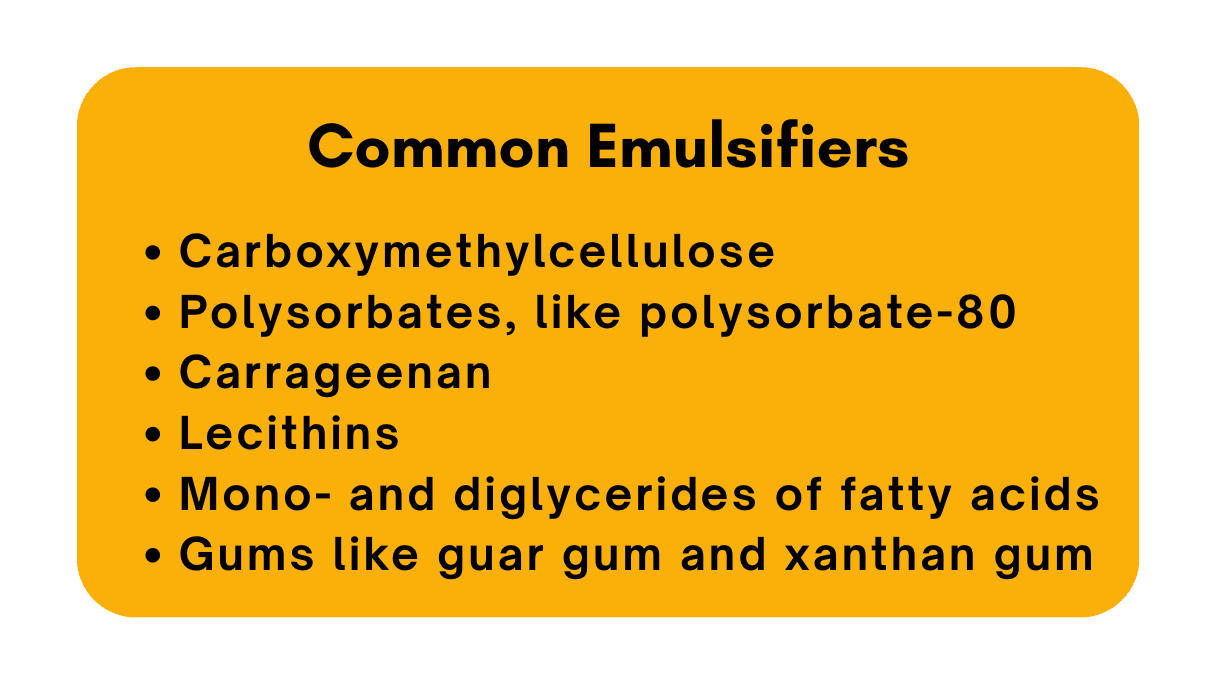
You don’t need to memorize these, unless you’re taking my course this semester, in which case… You might want to.
But you’ve likely seen them on labels.
Some have long-standing safety data. Others are being revisited as research evolves. And while they’re often grouped, they don’t all behave the same way.
That distinction matters.

What kind of foods are they found in?
Emulsifiers are most commonly found in processed and ultra-processed foods.
Of course they are.
But we’re living in 2026. Convenience matters. Time is limited. And for many people, processed foods aren’t occasional; they’re part of the daily routine.
So this isn’t about avoiding them entirely. It’s about knowing where they show up.
You’ll most often find emulsifiers in all sorts of processed foods. Here are a few examples, but this is just a sampling, not the full cast.
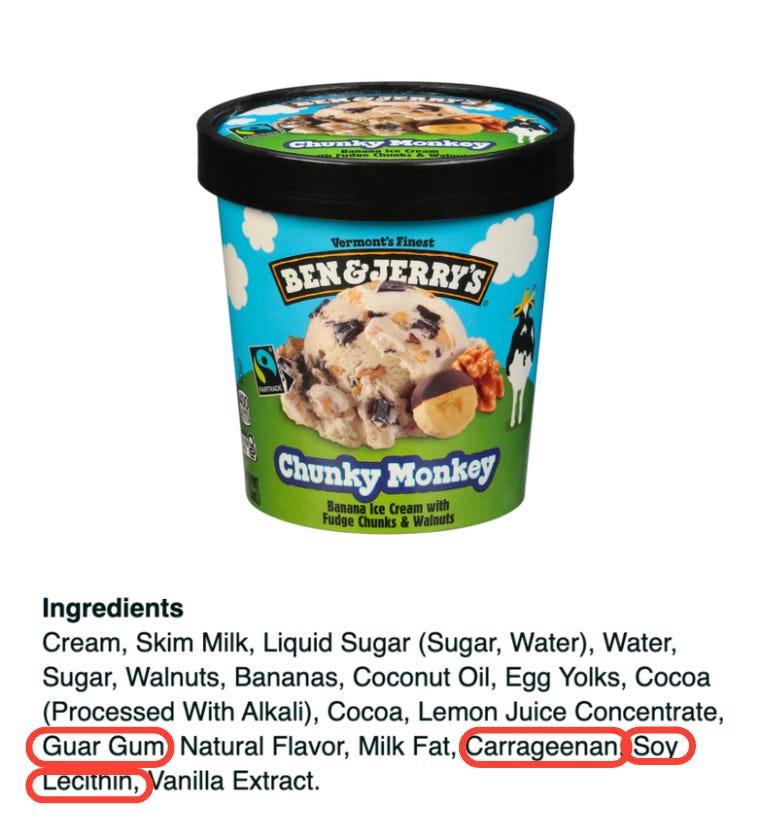
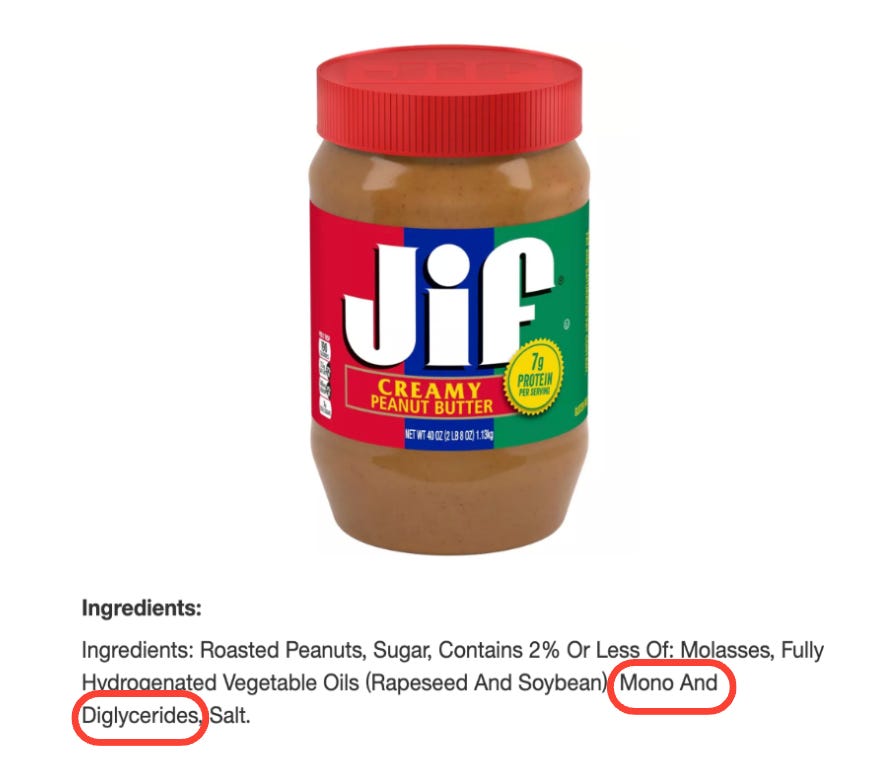
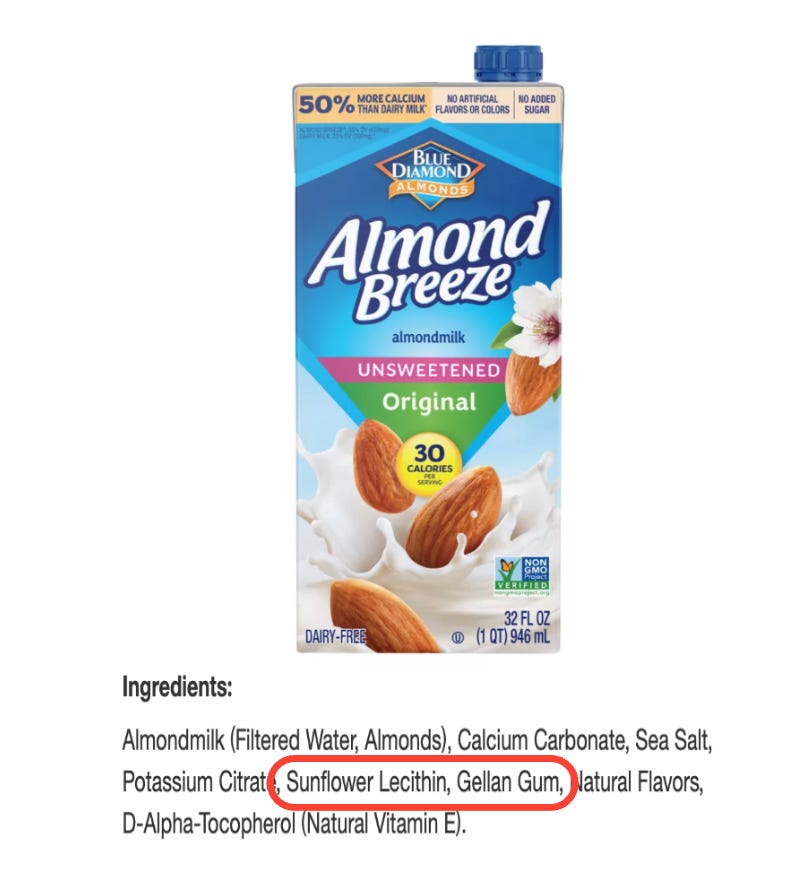
In many of these foods, emulsifiers aren’t just along for the ride; they’re doing real work. Holding structure, improving texture, keeping things stable long after they probably should have separated.
And it’s rarely just one. It’s common for a single product (like the ice cream and almond milk shown above) to contain multiple emulsifiers, which means exposure isn’t occasional; it’s layered.
So when you zoom out and look at how often these foods show up in your day, the question becomes simple: how much of this are you actually eating?

Got it. But what’s the problem with emulsifiers?
Most of the concern around emulsifiers centers on the gut.
The intestinal lining is protected by a mucus barrier that keeps bacteria at a safe distance from gut cells, allowing the microbiome to exist without constantly triggering the immune system. Think of it like the curtain between first class and economy; it’s a thin barrier, but it makes all the difference.
Certain emulsifiers appear to disrupt that system, like the passenger from economy who decides the front bathroom is fair game.

In animal studies, emulsifiers like carboxymethylcellulose (CMC) and polysorbate-80 have been shown to alter the gut microbiome, increase inflammatory signals, and weaken the mucus barrier. This allows bacteria to move closer to the intestinal lining, a phenomenon known as microbiota encroachment, which is linked to low-grade inflammation.
Human data are still limited, but one controlled feeding study offers an early signal. Healthy participants consuming high amounts of CMC for 11 days showed reduced microbiome diversity, lower levels of beneficial short-chain fatty acids, and evidence of microbiota encroachment in some individuals.
Cell studies suggest that some emulsifiers can also directly disrupt the intestinal barrier and activate inflammatory pathways.
Taken together, the studies point to a plausible pathway: emulsifiers may alter the microbiome, weaken the gut barrier, and promote inflammation.

I’m glad you mentioned research studies. Are there any large-scale ones?
(This is where some of you may want to skip down to #6. Totally fair, this one’s a bit inside baseball.)
There are. And one of the most talked about is the NutriNet-Santé study.
This large French observational study followed more than 95,000 adults and did something unusual. Participants recorded the specific branded foods they consumed. Researchers then built a detailed database of food additives, allowing them to estimate the intake of individual emulsifiers.
That’s what makes this study stand out. It moves the conversation beyond “ultra-processed foods” and starts to isolate specific ingredients.
The findings showed that higher intake of certain emulsifiers was associated with increased risk of cardiovascular and coronary heart disease. Cellulose-based emulsifiers, including carboxymethylcellulose and mono- and diglycerides, were among those most consistently linked.
Additional analyses found associations between:
Now, this is where we pause.
These findings don’t prove causation. Observational studies come with baggage, diet patterns, lifestyle, all the things that are hard to fully control for.
But they do move the conversation out of the hypothetical. This isn’t just happening in lab models or isolated experiments. It’s showing up in real-world data, at real-world levels of intake.

So, How Do I Know If the Foods I’m Eating Contain Emulsifiers?
It’s the emulsifiers in processed foods that are worth paying attention to, so knowing how to spot them on labels matters.
In the U.S., they’re listed by their chemical names: carboxymethylcellulose, polysorbate-80, lecithin, mono- and diglycerides, and others.
So yes, they’re disclosed. And yes, you need to know what you’re looking for.
But that’s where the clarity starts to fall apart.
Labels tell you if an emulsifier is present. They don’t tell you how much.
It’s a bit like reading a menu without prices. You know what’s there, but not how much you’re actually committing to.
So ingredient lists can point you in the right direction, but they’re not exactly giving you the full story of your exposure.

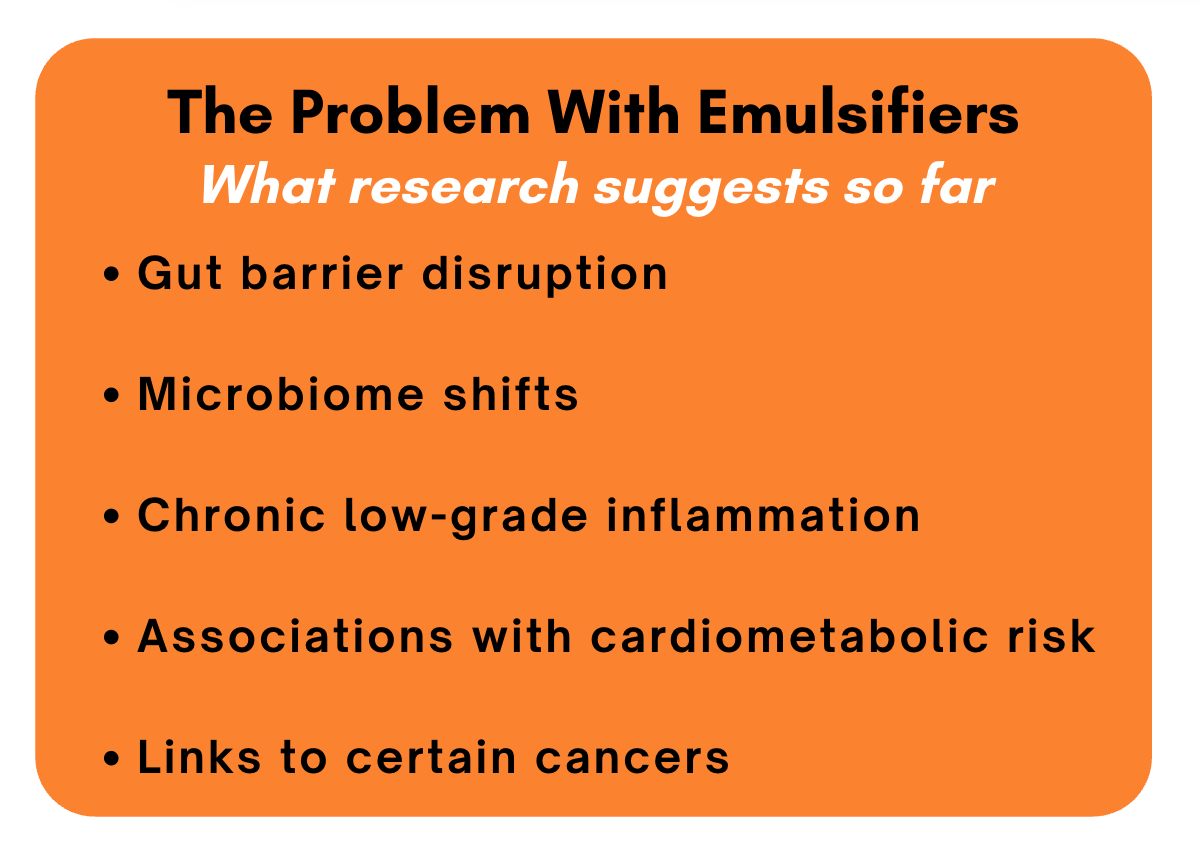
Emulsifiers are a functional part of modern food, but emerging research suggests that higher, repeated exposure may impact gut health, inflammation, and long-term disease risk.
This isn’t about avoiding them entirely. It’s about paying attention to how often they show up in your diet.
My advice? Read the ingredient list. The more it looks like something you could buy at a grocery store and cook with in your own kitchen, the better.
This isn’t about avoiding emulsifiers entirely. It’s about knowing where they show up, how often, and deciding how much of that you want in your day.